How to Write Hiragana (Detailed Version)
A 49-video playlist consisting of: overview, 46 individual hiragana videos, 2 videos on “modified” hiragana.
How to Write Hiragana.
Short & simple 15-video playlist.
How to Write Katakana
Short & simple 15-video playlist.
Complete Guide to Japanese Pronunciation.
Insanely comprehensive & thorough 50-video playlist on Japanese pronunciation, intonation, rhythm, devoicing.
Above are the videos I used & recommend for learning to read, write & pronounce hiragana & katakana.
Basic vocabulary: (Common word lists, JLPT N5 vocabulary book) etc…
Flashcard Example
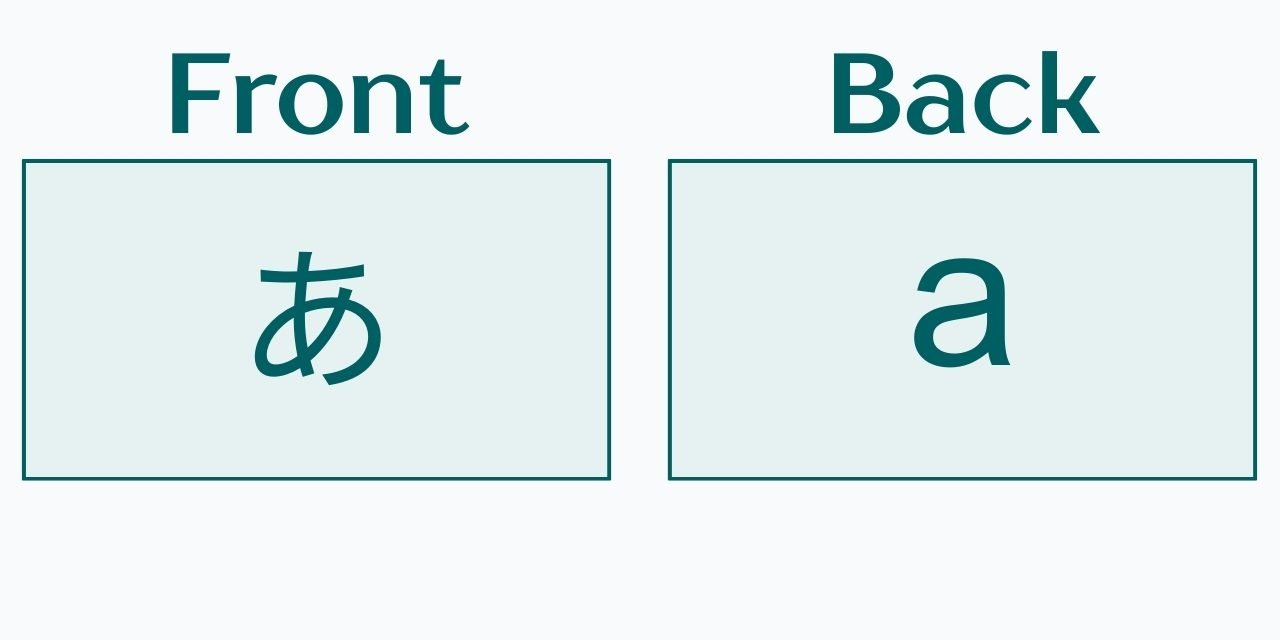
Step 1: Create 46 Flashcards
Step 1: Create 46 Hiragana Flashcards (Hiragana links)
Click the あ-link in row-a to watch a tutorial on how to write the character.
Practice writing until confident in your ability to correctly write it.
Create flashcard
Work downwards in the same column clicking links for row-i, row-u, row-e, row-o respectively.
Shift one column right and repeat, starting from row-a again.
Step 2: Learn Basic 46 Hiragana Pronunciations (Alphabet Links)
In the first column, starting from the top at “a”, watch the linked videos on pronunciation.
Next, in the 2nd row, starting left with “k” and moving right till “w”. watched the linked videos on pronunciation.
Step 3: Review flashcards
| 46 Basic Hiragana | Dakuten & Handakuten | ||||||||||||||
| k | s | t | n | h | m | y | r | w | g | z | d | b | p | ||
| a | あ | か | さ | た | な | は | ま | や | ら | わ | が | ざ | だ | ば | ぱ |
| i | い | き | し | ち | に | ひ | み | り | ぎ | じ | ぢ | び | ぴ | ||
| u | う | く | す | つ | ぬ | ふ | む | ゆ | る | ぐ | ず | づ | ぶ | ぷ | |
| e | え | け | せ | て | ね | へ | め | れ | げ | ぜ | で | べ | ぺ | ||
| o | お | こ | そ | と | の | ほ | も | よ | ろ | を | ご | ぞ | ど | ぼ | ぽ |
| Yōon | k | s | t | n | h | m | r | g | z | b | p | ||||
| きゃ | しゃ | ちゃ | にゃ | ひゃ | みゃ | りゃ | ぎゃ | じゃ | びゃ | ぴゃ | |||||
| きゅ | しゅ | ちゅ | にゅ | ひゅ | みゅ | りゅ | ぎゅ | じゅ | びゅ | ぴゅ | |||||
| きょ | しょ | ちょ | にょ | ひょ | みょ | りょ | ぎょ | じょ | びょ | ぴょ | |||||
With the help of the above table, you can learn to read, write, and pronounce each of the 46 basic hiragana. I recommend creating physical flashcards so that you can practice writing the kana. The flashcard should look like this:
Before writing the kana on the flashcard, practice on a separate sheet of paper until you are confident enough.
The 46 basic hiragana can be used to represent every sound in spoken Japanese; however, the 46 hiragana themselves don’t represent all the sounds.
Extra:
In the yellow section “Dakuten & Handakuten”, dakuten is added to the devoiced k, s, t & h kana, turning them into the voiced g, z, d, b kana. Handakuten is added to the h kana resulting in the p kana. Please use the links under the “Dakuten & Handakuten” heading for the detailed pronunciation videos.
Voiced vs. Unvoiced Sounds
Voiced Sounds: Use vocal cord vibration, you will notice a buzzing sensation in your throat.
Unvoiced Sounds: Do not use vocal cord vibration, no buzzing sensation.
Note: All vowels are voiced!
Within the red “Yōon” section, the consonant-いvowel kana are combined with a half-size katakana character (small や, ゆ, or よ) to combine with a preceding kana, altering the sound and forming a distinct syllable. Please use the alphabet links in the “Yōon” row for in-depth explanations.
How to Learn Hiragana: Complete Beginner’s Guide to Japanese Writing (2025)
SEO Notes for Implementation:
- Title tag: “How to Learn Hiragana (2025): Complete Beginner’s Guide + Chart”
- Slug:
/learn-hiragana/ - Meta description: “Master all 46 hiragana fast with a simple plan, clear charts, stroke order tips, and smart practice. Start reading Japanese today.”
- Featured image alt text: “Hiragana chart a-i-u-e-o grid printable with stroke order”
Master all 46 hiragana characters with a simple plan, clear charts, and smart practice—no prior knowledge required.
[CONVERSION CTA BOX – Style with green background/border] 📝 Download FREE Printable Hiragana Practice Sheets (PDF) – Perfect for offline writing practice! [Link: /downloads/hiragana-practice-sheets.pdf]
Table of Contents
- Quick Start (2-Minute Plan)
- What is Hiragana?
- Why Learn Hiragana First?
- Essential Resources & Tools
- The 46 Basic Hiragana Characters
- Step-by-Step Learning Method
- Advanced Hiragana: Dakuten & Handakuten
- Yōon (きゃ/しゃ/ちゃ…): Combination Sounds
- Practice Techniques & Tips
- Common Mistakes to Avoid
- Next Steps After Hiragana
- FAQ
Quick Start: Learn the Basics in 2 Minutes {#quick-start}
- Hiragana = core Japanese syllabary used for native words, particles, and grammar
- 46 basic characters; learn them in the grid (a, i, u, e, o × k/s/t/n/h/m/y/r/w + ん)
- Write with correct stroke order; say the sound as you write (muscle + sound memory)
- Study loop: Watch → Write → Make a card → SRS review
- Goal pace: 15–20 characters in 2 days, all 46 in ~1 week with daily 20–30 min reviews
What is Hiragana? {#what-is-hiragana}
Japanese uses three scripts: Hiragana (native words, grammar), Katakana (loanwords, emphasis), and Kanji (meaning-bearing characters). Hiragana is the entry point because it appears everywhere and unlocks basic reading and grammar.
Hiragana vs. Katakana vs. Kanji
- Hiragana: さかな (fish), particles like は/が/を, verb endings
- Katakana: カメラ (camera), software names, onomatopoeia
- Kanji: 学校 (school), 日本 (Japan). You’ll learn these after kana
Why Learn Hiragana First? {#why-learn-hiragana-first}
- Pronunciation foundation—every kana = one syllable-like sound
- Grammar access—particles and verb/adjective endings are written in hiragana
- Furigana training wheels—kids’ books and learners’ texts add hiragana above kanji
Essential Resources & Tools {#resources}
Recommended Video Tutorials
[VIDEO EMBED SECTION – Add lazy loading] Embed 2-3 key videos here: writing overview + pronunciation basics
- How to Write Hiragana (Detailed) — 49-video playlist (overview + 46 characters + 2 modified kana)
- How to Write Hiragana (Short & Simple) — 15-video playlist
- How to Write Katakana (Short & Simple) — 15-video playlist (for later)
- Complete Guide to Japanese Pronunciation — 50-video deep dive (vowels, rhythm, devoicing)
Study Materials You’ll Need
- Squared/grid paper (A4) or printable kana sheets
- Flashcards: physical or SRS (Anki, etc.)
- Beginner vocab list (JLPT N5 coverage is ideal)
Creating Effective Flashcards
Front: き (no romaji). Back: “ki” + one example (きのこ “mushroom”). Include stroke order GIF or arrowed image if possible.
The 46 Basic Hiragana Characters {#basic-46}
[NOTE: Replace with TablePress or responsive table plugin for better mobile experience]
TIP: Pronounce each cell aloud. を is usually pronounced “o” as a particle. ん is syllabic “n.”
[HIRAGANA CHART TABLE] Create a 6×11 table with the following structure:
aiueo∅あいうえおkかきくけこsさしすせそtたちつてとnなにぬねのhはひふへほmまみむめもyや—ゆ—よrらりるれろwわ———をnん (spans all 5 columns)
Pronunciation Pointers
- Japanese r is a quick tap (between r/l)
- ふ is closer to fu with a soft/labial f (not English “foo”)
- し = “shi”, ち = “chi”, つ = “tsu”
- Particle は is pronounced “wa”; へ often “e”; を “o”
Step-by-Step Learning Method {#method}
- Create cards for the a-column (あ, い, う, え, お): watch your “how to write” video, write each 5–10×, then make a flashcard
- Work down each consonant row (k → s → t → …), repeating watch → write → card
- Daily SRS: 10–15 min of yesterday’s cards, then add 10–15 new cards
- Write words: combine known kana to copy 2–3 real words/day (e.g., あさ, すし, ねこ)
7-Day Sample Plan
- Day 1–2: Vowels + k/s (15–20 chars)
- Day 3–4: t/n/h (15)
- Day 5: m/y (5–8)
- Day 6: r/w/ん (6)
- Day 7: Review test (read a children’s page with furigana)
PRO TIP: Say the syllable every time your pen touches the paper; pair sound + movement to build recall.
Advanced Hiragana: Dakuten & Handakuten {#dakuten}
Dakuten (゛) voice the consonant; handakuten (゜) make p sounds.
[MINI TABLE – Style with smaller font]
TransformExamplesk → gか→が, き→ぎ, く→ぐ, け→げ, こ→ごs → zさ→ざ, し→じ, す→ず, せ→ぜ, そ→ぞt → dた→だ, ち→ぢ, つ→づ, て→で, と→どh → bは→ば, ひ→び, ふ→ぶ, へ→べ, ほ→ぼh → pは→ぱ, ひ→ぴ, ふ→ぷ, へ→ぺ, ほ→ぽ
Note: じ/ぢ and ず/づ sound the same in modern standard Japanese; ぢ/づ are rare and appear in specific words or rendaku.
Yōon: Combination Sounds (Small ゃ/ゅ/ょ) {#yoon}
Attach a small ゃ/ゅ/ょ after an i-row kana to blend: きゃ (kya), しゅ (shu), ちょ (cho), etc.
[YOON TABLE]
Row-ya-yu-yok-きゃきゅきょs-しゃしゅしょt-ちゃちゅちょn-にゃにゅにょh-ひゃひゅひょm-みゃみゅみょr-りゃりゅりょVoicedぎゃ/じゃ/びゃ/ぴゃぎゅ/じゅ/びゅ/ぴゅぎょ/じょ/びょ/ぴょ
Practice Techniques & Tips {#practice}
Daily Study Rhythm
- Warm-up: 5 random reviews from yesterday
- New: add 10–15 kana; write each 5–10×
- Apply: copy 3 words or one sentence with furigana
Memory Boosters
- Mnemonics: e.g., あ looks like a person stretching saying “ahh”
- Minimal pairs: drill look-alikes together (ぬ vs ね, れ vs わ)
- Audio shadowing: say each kana cleanly in a steady rhythm
Reading Sources for Practice
- Children’s pages with furigana
- Beginner manga panels annotated with kana
- Simple blog posts where you can hover furigana
[INTERNAL LINK OPPORTUNITY] Try reading practice with our Japanese numbers guide or days of the week once you know basic hiragana!
Common Mistakes to Avoid {#mistakes}
Look-alike Confusions
- あ vs お: お has a small loop on the right
- は vs ほ vs ま: watch the middle/extra stroke and shape
- ぬ vs め vs ね: focus on where the loop connects
Pronunciation Pitfalls
- Long vowels: おう / こう lengthen the sound (e.g., こうこう)
- Small っ (sokuon): doubles the following consonant (きって = “kitte”)
- Devoicing: す/し may whisper between voiceless consonants; don’t drop the vowel entirely
Writing Errors
- Ignoring stroke order (reduces speed/legibility)
- Inconsistent proportions—use grid boxes at first
- Spacing: Japanese is written without spaces; learn word boundaries by reading
Next Steps After Learning Hiragana {#next-steps}
[INTERNAL LINK SECTION – Great for SEO and user retention]
- Start Katakana (loanwords & names)
- Learn Core Japanese Particles (は/が/を/に/へ/で/の/と)
- Build N5 Vocabulary (200–500 high-frequency words)
- Practice with our guides:
FAQ {#faq}
How long does it take to learn all hiragana? With daily 20–30 minute sessions, most learners recognize all 46 within 5–7 days and write them cleanly in 10–14 days.
Do I need romaji? Use romaji only as training wheels on the back of flashcards. Read and write in kana from day one.
Is stroke order really important? Yes—correct order makes writing faster and more legible, and helps you memorize shapes reliably.
What about obsolete kana like ゐ/ゑ? They’re obsolete in modern Japanese; focus on the standard 46.
Should I learn katakana before kanji? Yes. Master hiragana, then katakana, then begin basic kanji alongside grammar and vocabulary.
Can I learn hiragana without writing practice? Writing reinforces memory significantly. Even if you only plan to type, hand-writing helps recognition and retention.
What’s the difference between hiragana and romaji? Romaji uses English letters to represent Japanese sounds. Hiragana is the actual Japanese writing system. Learn to read hiragana directly instead of relying on romaji.
[STRUCTURED DATA NOTES FOR DEVELOPER] Add JSON-LD structured data for:
- HowTo schema with the 5 main steps
- FAQPage schema for the FAQ section
- Article schema with author, date, etc.
[FINAL CTA – Style as prominent box] 🎯 Ready to start? Download your FREE hiragana practice sheets and begin with the vowel sounds (あ い う え お) today!