Interested in Learning Japanese?
I have spent the past 2 years learning Japanese. Of those 2 years, 15 months of it I spent in Japan. I created this guide because I think my experience can be a useful prospective for other learners, especially for beginners to help them create a more effective way of learning that works for them.
There is a lot of information online about how to learn Japanese, what resources to use, how long to study every day, etc… I definitely think that some methods/resources are better than others, however, I feel a lot of it comes down to personal preference, what makes sense for you, and what keeps you interested. I believe the only way to fail, is to give up.
With that said, this guide is split up into 2 main sections.
The first section “Japanese From Zero” is a very general outline of the Japanese language, so that you know enough to understand the second section.
In the second section I describe my journey with learning Japanese, as well as my recommended learning methods & resources.
Why Do You Want to Learn Japanese?
Language learning is a lifelong endeavor, and like any long endeavor, it is best to be well-prepared from the start. How can you prepare yourself to learn Japanese? It’s simple! Just ask yourself the two simple aforementioned questions! For most people, their reason for learning and goal are intertwined. They are already consuming Japanese content, and they want to be able to consume the Japanese content in it’s
Graphic Collage “Even if you never become fluent, learning the basics opens doors.”
What Are Your Goals?
Why Do People “Fail” to Learn Japanese?
Expectations & Study Methodology. I believe these are the 2 largest factors that contribute to “failing”. Why add quotation marks to the word? Because can always try again! You can use your past experiences to strengthen your resolve, refine your way of studying, find what works for you, and succeed!
Japanese From Zero
1 The Japanese Writing System
The written Japanese Language consists of three different writing systems: Hiragana, Katakana, and Kanji. I often see people online using this fact to support their claim that written Japanese is extremely complex. I disagree with this claim. Initially Japanese had no writing system, which is why they have Kanji. However, just using Kanji didn’t fit well with the Japanese language and its grammatical rules, which is why over time they developed Hiragana (and Katana). This effectively reduced the required number of Kanji and enabled a more seamless flow between written and spoken language.
1.1 Hiragana (ひらがな)
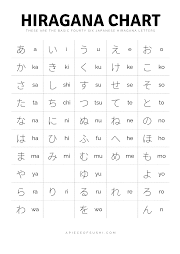
Hiragana is a Japanese syllabary—a writing system where each character represents a syllable rather than a single sound or letter. It contains 46 basic characters, which together allow you to express every sound in the Japanese language.
In fact, you could technically write anything in Japanese using only hiragana, though it would look unnatural without kanji and katakana.
Hiragana is primarily used for native Japanese words, grammatical particles, and verb endings, making it essential for reading and writing.
Below is a chart containing the 46 characters, as well as the sound they represent
1.2 Katakana (カタカナ)
Katakana (カタカナ):
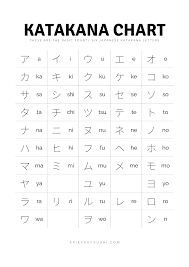
While hiragana is used for native Japanese words, katakana is a parallel syllabary with the same set of 46 basic sounds, primarily used for foreign loanwords, onomatopoeia, and scientific terms.
It is also used stylistically (similar to italics in English) due to its sharp, angular style. I have often seen it used for company names, signs, logos, and anime/manga titles.
Below is a chart containing the 46 characters, as well as the sound they represent.
1.3 Kanji (漢字)
Kanji are Chinese characters that were adopted into Japanese writing. Unlike hiragana and katakana, which are purely phonetic, kanji carry meaning in addition to sound. For example, the character 水 means “water,” and 火 means “fire.”
In modern Japanese, there are officially 2,136 “Jōyō Kanji” (常用漢字), which are the standard set taught in schools and used in daily life. Beyond these, thousands more exist, but most texts and media rely on the Jōyō list.
Each kanji usually has two types of readings:
- On’yomi (音読み, “Chinese reading”) — based on the original Chinese pronunciation.
- Kun’yomi (訓読み, “Japanese reading”) — the native Japanese word for the meaning of the character.
2 Basic Grammar
2.1 Sentence Structure
Sentence structure is the grammatical ordering of the words within a sentence.
English primarily uses an SVO (Subject-Verb-Object) sentence structure, while Japanese employs an SOV (Subject-Object-Verb) sentence structure. Let’s explore what this means and how the two are different through the graphic below.
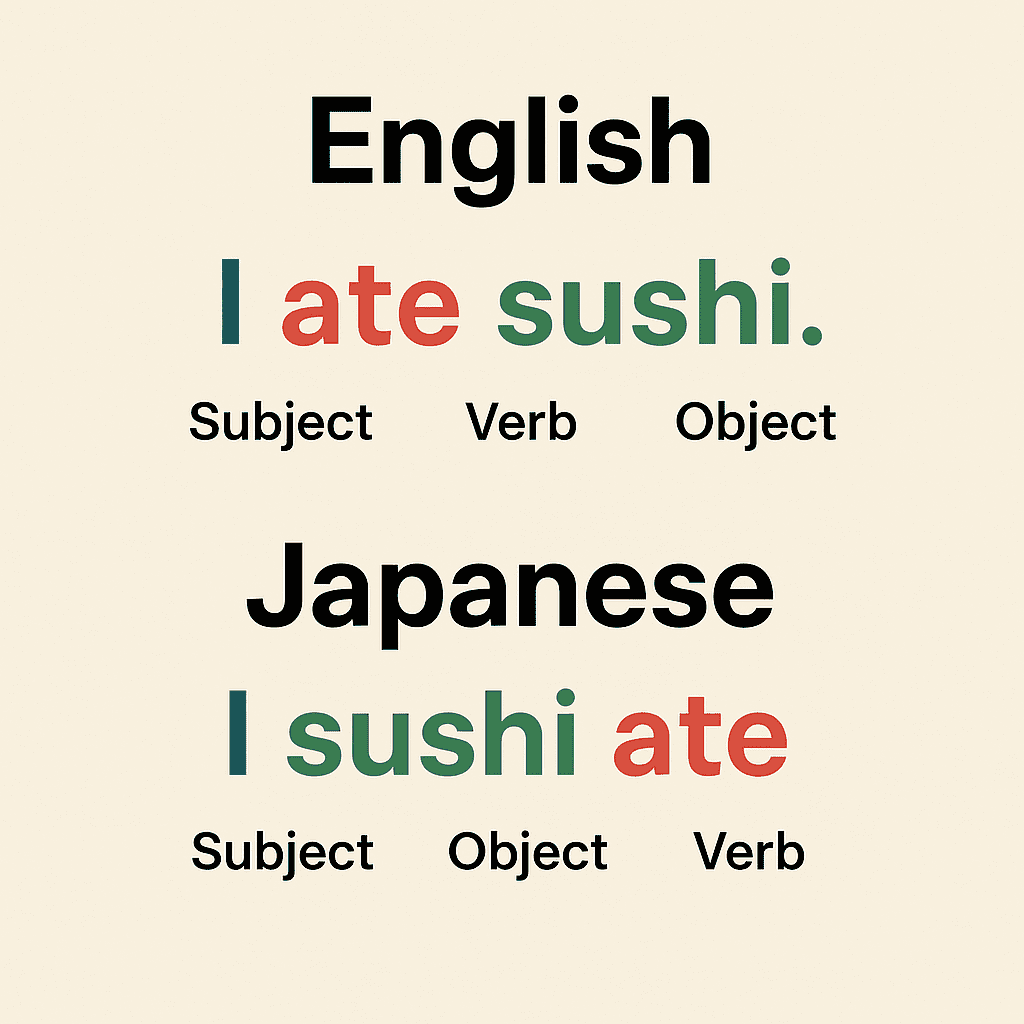
As you can see, the verb “ate” appears at the end of the sentence in Japanese. This one “little” difference is part of what makes comprehending Japanese so difficult as a learner whose native language employs the SVO structure.
It is important to note that a sentence in Japanese doesn’t have to end with a verb, it can also end with:
an adjective
a copula like です (desu).
If you are interested in a more comprehensive explanation of Japanese Sentence Structure, read my article here.
When I first began learning Japanese, I remember it feeling extremely unnatural to process information in the SOV ordering and would often find myself translating the Japanese back to English and reordering to SVO as it felt more natural. As I became more familiar with the language, comprehending without translating or reordering became second-nature. So don’t be too hard on yourself early on.
Sentence Enders
2.2 Verbs
In modern Japanese, verbs consist of two parts: a verb stem (usually written in kanji) and a suffix that always ends with an “u” sound (like in “goo,” “too,” or “chew”).
Based on their suffix, verbs are grouped into Ichidan and Godan categories. Each group follows its own rules for conjugation—changing into forms like past tense, negative, or polite speech.
While many languages (like English, French, or Spanish) have lots of irregular verbs, Japanese has only two.
2.3 Adjectives
Big, Small, Hot, Cold, Bright, Dark. These are all adjectives, words that describe a noun. Beginners are often taught that there are two types of adjectives, い-adjectives & な-adjectives. This is a heavily debated topic which, frankly, is insignificant to a beginner. However, if you are interested in my opinion, read this.
い-adjectives
This set of adjectives are often called い-adjectives due to the fact that all of them end with the character い(pronounced like the letter “e” when saying the alphabet). These adjectives all follow the same conjugation rules when changing them into past-tense, negative, etc… Sound familiar?
な-adjectives
This class of “adjectives” behave like nouns in most cases. However when used in combination with particles they can modify nouns and also act like adverbs. For example, when the character な is placed between a な-adjective and a noun, it modifies that noun with the descriptive quality of な-adjective to the left, effectively acting like an adjective. Hence the name.
Example
2.4 Adverbs
Adverbs, words that describe an action. They can be derived from both い-adjectives and な-adjectives. There is also a large amount of fun-to-say onomatopoeic adverbs which I talk about here.
2.4 Grammatical Particles
Japanese particles are small grammatical markers which describe a word’s relationship to other words in the sentence. Particles are always written in Hiragana.
Japanese Particles always come after the word they govern; hence, they are postpositions.
English “Particles” come before the word they govern; hence, they are prepositions.
In Japanese, word order does not change the fundamental meaning of the sentence.
In English, word order functions to describe the relationship of the words within a sentence, and thus affects its fundamental meaning.
These are a subset of the fundamental particles of Japanese. As you progress with Japanese, you will develop a stronger, broader understanding of each particle and its respective functions.
The
2.5 Non-Grammatical Particles
These particles always come at the end of a sentence. They do not have any influence over the relationship of the words within the sentence, rather, they influence the sentence as a whole.
They are typically used to change the sentence’s tone, “vibe”, or to convey some other nuance befitting the situation.
If you have watched anime, then you have definitely heard よ(yo) and ね(ne) before, which are the most fundamental of the sentence-ending particles. There is a whole slew of other sentence-ending particles, some of which are show below.
GRAPHIC
| Topic | Learning Goal #1 | Learning Goal #2 |
| Writing System | Hiragana | Katakana |
| Grammar | Sentence Structury | |
| Verb Basics | Ichidan | Godan |
| Adjective Basics | i-adjective | na-adjective |
| Particle Basics | wa | ga |
| ni | de | |
| to | wo | |
| Sentence Enders | yo | ne |
| Study Methods | Immersion+Vocab+Grammar | Textbook |
| Study Resources | ||
| FAQs |
My Personal Japanese Learning Journey
Why Did I Decide to Learn Japanese?
Since I was a child, I always had an interest in learning a second language. Furthermore, I was interested in learning a language which had a non-alphabetic writing system.
During my first year at university, I pursued this interest through 2 semesters of introductory Chinese classes. The problem was, I was only learning the language… I wasn’t using the language outside the context of the course, and I wasn’t consuming any Chinese content of any kind. As such, when the courses ended, so did my pursuit of learning Chinese.
Fastforward 4 years, to the height of the Corona virus, I’m stuck inside the house with nothing to do. Per the recommendation of my friend, I started to watch anime for the first time–Attack on Titan進撃の巨人. I was enthralled. Upon finishing, I immediately started watching Naruto.
Halfway through the series, it dawned on me. Why not learn Japanese? I always wanted to learn a non-alphabetic language, and I was already spending hours every day watching anime, listening to Japanese. The more I learned, the more I could understand, and the more I could enjoy the content in its original form. Plus, it was covid, what else was I to do at home all day?
Now that the “why” is out of the way, here is timeline summarizing the when, what, and how’s of my learning journey. Interested in a more detailed timeline?
Week 1
As I had just started, I had no idea what I was doing. I remember simply searching up “How to Learn Japanese” and watching a couple of videos. The videos I watched unanimously recommended I start by learning Hiragana (and Katakana), then learn the fundamentals of the language through the Genki: An Integrated Course in Elementary Japanese Vol. 1 [3rd Edition] textbook & workbook.
For those unfamiliar with the textbook:
GENKI: An Integrated Course in Elementary Japanese is a study resource for people who are starting to learn Japanese. It is designed to comprehensively build communication competencies across all four skill areas–listening, speaking, reading, and writing. GENKI consists of 23 lessons, divided into two volumes of textbooks and workbooks.
It is often used as the foundation for teaching introductory Japanese courses. For example, the Japanese courses at the university I attended used it as such.
Focus
- Hiragana
- Memorize using handmade flash cards.
- Practice pronunciation with this playlist.
- Practice writing with this playlist.
Week 2-4
At this point I felt I had enough of an understanding of Hiragana to begin working through the Genki textbook & workbook.
I also realized I still had not studied Katakana, so I modified my flashcards to include Katakana beside the Hiragana. I continued to use these for learning and review.
Focus
- Genki I Lesson 1 & 2
- Katakana & Hiragana
- Added Katakana to pre-existing flashcards.
- Memorize & review with flashcards.
- Practice pronunciation & writing.
Months 2-4
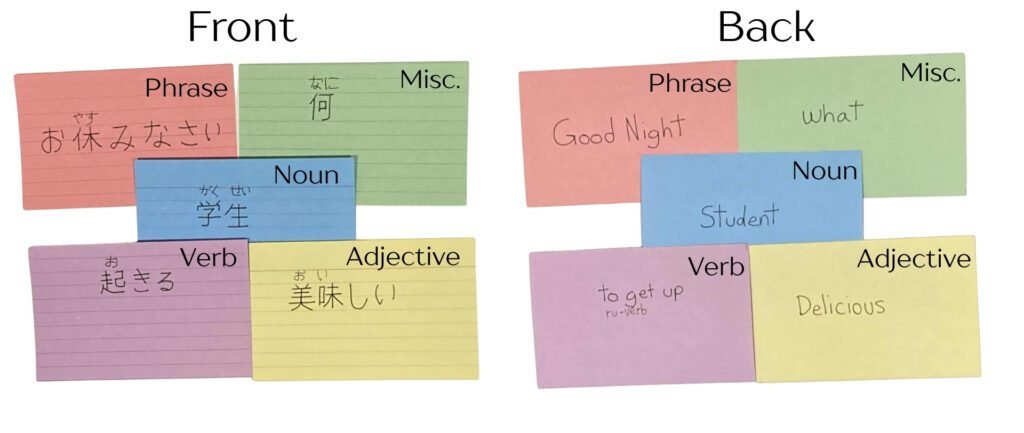
Progress slowed down to ~1 lesson/month. I felt I was having trouble with memorization and recall of the vocabulary, especially since Kanji had been introduced in Lesson 3. At this point I began to create flash cards of all the vocabulary from each lesson, color-coded by word type.
Focus
- Genki I Lessons 3-5
- Vocabulary Flashcards
- Front: Japanese word in Kanji w/ Furigana.
- Back: English definition
- Color-coded by word type.
Month 5 October
At this point, I had studied Japanese for 4 months. At first, learning Hiragana & Katakana felt quite simple and rewarding but as I progressed Kanji, sentence structure, particles etc… I began to feel that just using the textbook, workbook, and flashcards was insufficient.
I wanted a more structured way to learn Kanji and also more exposure to comprehensible Japanese; as it contains real, concrete examples of grammar & sentence structure. With those two thoughts in mind, I did some googling and ended up discovering WaniKani for kanji, and a book of beginner-targeted short stories.
WaniKani
WaniKani is a web-based spaced repetition system (SRS) application which utilizes mnemonics to teach you kanji and vocabulary. In order to explain further, a basic understanding of radicals is required.
Radicals are the building blocks of kanji. You can imagine radicals as Lego blocks, which you put together to create a kanji. While a single kanji (composed of radicals) can represent a word, they are more commonly placed beside each other to form compound words– jukugo.
GRAPHIC
WaniKani utilizes mnemonics and spaced repetition to assist you in memorizing radicals, kanji, and words, in that order. Radicals>>Kanji>>Words. The application is comprised of 60 levels. Each level requires ~7 days to complete, containing new radicals, kanji, and words. The first 3 levels are free, while the latter 57 require you to have a membership.
I purchased the membership upon completion of the free levels, aiming to stick to ~7 days per level.
Japanese Short Story Book
I always preferred reading hard-copy books, and I wanted to start asap, so I searched for “Japanese Beginner Book” on Amazon and chose Japanese Short Stories for Beginners: 20 Captivating Short Stories to Learn Japanese & Grow Your Vocabulary the Fun Way! as the other options seemed less story-centric and more learning/conversation-centric.
Each short story has line-by-line translation into English, a vocabulary list, a summary, and a little quiz (with answers). I felt quite satisfied with this purchase, as it was perfectly suited to my Japanese level at the time.
Focus
- Genki I Lessons 8 & 9
- WaniKani Levels 1-4
- Short Story #1
Month 6 November
Focus
- Genki I Lessons 10-12
- WaniKani Levels 5-8
- Short Story #2
Month 7 December (Some Things Changed)
Discovered Cure Dolly. Began to watch her videos.
Having finished Genki Volume 1 in the prior month, I found myself at a crossroads. Should I follow the natural progression of doing Genki Volume 2? Are there alternatives? Other textbooks? Other ways of studying?
Something just didn’t feel right. The Japanese I encountered in the “wild” was often at odds with my textbook understanding of the language. It felt like the Genki textbook was teaching me neither natural Japanese nor the fundamental mechanics of Japanese.
One day, I discovered a channel called Organic Japanese with Cure Dolly who had a 93-video playlist called Japanese from scratch: the game-changing course in organic Japanese. After watching just the first video, I was sold. From that point on, instead of the textbook(s), I would watch the above video series.
Focus
- Japanese from scratch: the game-changing course in organic Japanese
- WaniKani Levels 9-12
- Short Story #3
Month 8 January (Some More Things Changed)
I figure at this point I should mention that the following month I was going to move to Japan with a friend for a year abroad. So yeah, this was a busy month of learning.
Anki
With the influence of Cure Dolly’s videos, I stopped using WaniKani and began using Anki. Why? Because I wanted to have more control over what I was learning/reviewing.
Anki is an SRS flashcard application that allows you to create your own flashcards, custom flashcard types/formats & flashcard decks. There are also more advanced settings/features, see here for a full guide.
There are generally two ways of using Anki.
- Download a pre-built vocabulary/sentence deck
- Create your own deck from scratch which you populate with vocabulary through sentence-mining content you consume.
I decided that option 2 was what I wanted, especially with the help of AwesomeTTS plugin for Anki, and the Yomitan browser extension. See below for a brief summary of them.
AwesomeTTS– Anki plugin that is capable of generating high-quality text-to-speech audio recordings.
Yomitan– A browser extension that generates a pop-up window containing Jap->Eng or Jap->Jap dictionary definitions for user-selected text. This is extremely helpful when reading/watching relatively difficult Japanese content, as you can quickly translate/define unknown words on the fly. Furthermore, the extension can be configured to locally connect to your Anki app, allowing you to add the pop-up window vocabulary/sentence to your Anki deck at the click of a button.
If you are interested in how to set this all up, see my guide.
Language Immersion
One day, I watched a Cure Dolly video that was outside of the “Japanese from scratch” playlist.
Transition to Immersion! Easier (and earlier) than you think! Learning Japanese by full immersion.
In this video, Cure Dolly recommends transitioning to language immersion learning after watching the first ~20-30 videos from the “Japanese from scratch” playlist.
Why choose language immersion over classroom/textbook learning? The answer is obvious when you think about it. What is your goal? Is it to become adept at learning Japanese? Or is it to become adept at Japanese? There is a difference. If your answer is the latter, then why spend 80% of your time studying Japanese, and only 20% of your time actually using Japanese. Shouldn’t it be the other way around? With that in mind I decided to:
Minimize study time (only the necessities).
Maximize immersion time.
I attempted to put the above into practice with an 80/20 time allocation rule for immersion/studying, but I realistically ended up with ~60/40.
JLPT N5 Vocabulary Book
Considering I was moving to Japan in one month, I felt that my vocabulary was severely lacking. After completing GENKI Volume 1 I “knew” ~500-600 words, however, a large amount of them were extremely topic-specific.
Therefore, I decided to purchase 1000 Essential Vocabulary for the JLPT N5. I wanted a physical copy of something that I could conveniently use for vocabulary study & review at home, on transit and on break at work.
The book was divided into several sections, with each section having a general theme such as “Time”, “Family”, “Work”, etc… I was unbothered when I encountered a word I already “knew” as I took it as an opportunity for further review.
italki
I was already 8 months into learning Japanese, and (aside from GENKI speaking exercises) I had essentially zero experience speaking the language. I didn’t have anyone to speak Japanese with, so I did some research and discovered italki.
italki is an online language learning platform that connects students with teachers for one-on-one conversation & tutoring.
At the time I booked 5×90-minute sessions for $72 USD.
As of now, there are 1000+ Japanese native speakers providing conversation & lessons from as low as $5USD/hr. Bundle/Package deals are also available.
If you are interested, you can register an account here. Registering with this link will get you $10 USD in credits upon your first purchase.
Focus
- Cure Dolly Grammar Series
- Anki sentence mining + reviews
- italki
- N5 vocabulary book
- Short story #4
- Other immersion: Anime, Podcasts
Month 9 (Location Changed. To Japan.)
I arrived in Japan with my childhood friend; we booked in advance a month-long Airbnb in Sumida ward of Tokyo. We arrived at our place without issue, unpacked a little, then went to bed.
The next day we woke up ready to speak Japanese at stores & restaurants, make Japanese friends, and become fluent in 6 months! As expected, reality wasn’t aligned with our expectations.
I was essentially unable to communicate or interact using Japanese. I could read, write, speak, and listen at ~JLPT N5 level, but in reality, that meant little-to-nothing. In reality, there are various factors that come into play such as:
- Speaker (Other person)
- Voice (deep, grumbly, high, thin, etc…)
- Speed (fast, normal, slow)
- Rhythm (consistent speed? slows down? speeds up? pauses?)
- Intonation
- Local accent
- Vocabulary (slang, simple words, unknown words)
- Grammar (slang? correct textbook grammar? omitting grammar?)
- Mood (desire to communicate with foreigner?)
- Environment
- Echoes
- Noise
- Abrupt loudness
- Reply time constraint/pressure
- Varies by situation
- At a convenience store or restaurant? Are people waiting in line?
- Is the other person patient? Do you know them well?
- Short conversation in passing? Sitting down for a beer or coffee together?
- Respectful Language
- Casual? Semi-formal? Formal? Super-formal?
- Your own internal state
- Ability to focus
- Energy level
- Genuine interest
- Mood
- Expectations
- Introversion/Extroversion
- Internal distractions (thoughts, emotions)
What I quickly learned was the “best” reply isn’t necessarily the best reply. What often matters more is the flow of the conversation.
You could spend time wracking your brain for that one word that fits perfectly, or figure out how to use grammar that’s concise, natural, even eloquent. How much time will that add to your response time? 1s? Not bad. 10s? Too long in most situations. 30s-1 minute? Too long in almost all situations.
In most situations the best reply is the quickest possible sufficient reply. Adaptability is extremely important. If you’re interested, this an article I wrote on Adaptability & Communication Strategies when Speaking Japanese.
I am a relatively shy, introverted person. In combination with my ~N5 level Japanese, it was difficult to strike up conversations. I didn’t want to waste people’s time, especially for the selfish reason of improving my Japanese.
Therefore, with a few exceptions, I continued immersing/studying just as the month prior.
Anki
One change I made compared to the month prior was the back of the Anki flashcards. Previously I was using only English (definitions, sentences, etc…) on the back of the flashcards. I decided that if I want to be adept at Japanese, and not just adept at learning Japanese, then it would make more sense to learn & understand new words through the lens of Japanese and not English.
GRAPHIC?
Mixed Japanese/English Conversation
I ended up making a Japanese friend who I met by chance while working out in a park during a torrential downpour. His name is Kotaro. Kotaro spent some time in America as an exchange student, so he was able to speak some English.
When we would converse, I would often speak in Japanese (and he would correct me if needed), and Kotaro would often speak in English (and I would correct him if needed). It felt natural, as we could both easily understand our native language. I feel grateful to have met Kotaro, he helped me improve my Japanese, and above that he is a good friend. To this day we stay in touch.
Light Novel: Blue Lock
There was a bookstore in a mall near where I was living which I browsed with my friend one day. For context, I have played soccer since I was 5, and enjoyed watching the Blue Lock anime, so when I found the Blue Lock light novels, I was ecstatic. Leafing through the book, the difficulty appeared high, but not insurmountable. The perfect challenge! I often spent time reading this book at a nearby Doutor cafe.
Focus
- Cure Dolly Grammar Series
- Anki sentence mining + reviews
- N5 vocabulary book
- Short stories #5 & #6
- Blue Lock #1
- Conversation w/ friend
Month 10 March
At the end of our month in Tokyo, my friend and I took the bullet train to Osaka. We had another pre-booked 1-month stay in Osaka’s Ikuno ward.
In terms of language learning, not much was different to the month prior. I had improved a little all around, my speaking was getting stronger, especially in restaurant/convenience store scenarios.
Sento (Japanese Bathhouse)
Ikuno Ward is known as a bathhouse battleground (銭湯激戦区). In other words, there are a lot of them. Call it a fluke, chance, fate; our rental was next-door to a bathhouse. One day my friend and I decided to go, and we were instantly hooked. From that day onwards I would go ~3-5x a week. The bathhouse is not just a place you go to clean yourself. It is a place to unwind, and a source of community. If you’re interested, I wrote an article/guide.
Anyways, I suppose a white man in a local bathhouse is a rare occurrence, as people would often ask where I was from and make small talk. I even became friends with some of the regulars. The bathhouse became a source of community & conversation practice for me.
Dating Apps
I was single, why not? I downloaded bumble and used it for the duration of the month. It was quite enjoyable talking with different people every day and learning more about how Japanese people (more specifically females) texted. It definitely is one way to immerse. Near the end of the month, I realized I had feelings for a girl I had gone on a few dates with and had been texting, so I deleted the app.
JLPT N5 Vocabulary Book
I reached the point where I had reviewed and knew mostly every word, so I added in bulk the remaining words I was still iffy on into Anki. After doing so I didn’t use the book again.
Focus
- Cure Dolly Grammar Series
- Anki sentence mining + reviews
- Short stories #7-10
- Blue Lock #2
- Messaging/Texting
- Conversation
Month 11 April
After Osaka was Kobe (Sannomiya District), it was our last 1-month stay that we had pre-booked through AirBnb. Again, not much was different in my language learning routine. I was steadily progressing in reading, writing (texting), listening, and speaking. The one difference was I now had a girlfriend.
Girlfriend
The girl I met through Bumble, the one I realized I had feelings for; she was a Chinese international student who was studying as a graduate student at Kyoto University. We explored new places together, and she showed me some of her favorite places too. Since we were together so often, we spoke a lot– sometimes English, usually Japanese. I learned a lot of Japanese from her.
Focus
- Cure Dolly Grammar Series
- Anki sentence mining + reviews
- Short stories #7-10
- Blue Lock #2
- Messaging/Texting
- Conversation
Study: Same
Month 12 May
My friend came to visit, and we travelled around Japan for 3 weeks. As such, I dedicated very little time towards language learning. On the other hand, because we were traveling, there were many opportunities to use Japanese.
Focus
- Anki reviews
- Organic interactions/conversation
- Blue Lock #3
Month 28 (Present)
Focus
- NHK News
- Japanese Music
- Anki sentence mining + reviews
- Retro text-based horror adventure games
- More Native content, news broadcasts, podcasts, etc…
- Talk with Japanese friend 1-2x a month
One Year Summary
Review
What worked
What didnt work
Japanese From Zero
As a (Japanese) language learner there are four areas of focus.
- Input
- Reading
- Listening
- Output
- Writing
- Speaking
Vocabulary and grammar form the foundation of all language skills: reading, listening, writing, and speaking. Without vocabulary—the words themselves—and grammar—the rules for combining and interpreting those words—there can be no communication, written or spoken. Naturally, your ability in each of the four skills depends on the breadth of your vocabulary and the depth of your grammatical knowledge.
Language Immersion Method
Language immersion means surrounding yourself with Japanese as much as possible—listening, reading, and absorbing it in real contexts. A practical approach is to devote around ~80% of your time on language acquisition through immersion with comprehensible input (materials you can mostly understand), with the remaining ~20% focused on structured learning of vocabulary, grammar, and kanji.
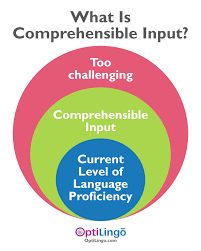
Comprehensible input is a concept introduced by linguist Stephen Krashen in his book Principles and Practice in Second Language Acquisition (1982). In it, he proposed the Input Hypothesis, which explains how language acquisition progresses. The idea is simple: we acquire language when we understand the meaning of messages whose form/structure is just slightly beyond our current ability.
Krashen expressed this as i + 1, where i represents your current level of competence, and +1 is the next step—language that’s a little more advanced but still understandable with context. In other words, if the input is too easy, you don’t grow; if it’s too hard, you can’t follow. But when it’s just beyond your comfort zone, that’s when real acquisition happens.
In reality, even unfiltered exposure to the language has its place in acquisition. Within what may seem like incomprehensible input, there are often small pieces you can understand—and these still contribute to progress. This is a complex but fascinating aspect of the immersion method.
📖 Want to go deeper?
Check out my article on Krashen’s Second Language Acquisition Theory. It breaks down the five hypotheses and explains how they connect to the immersion method.
In practice, this ratio shifts depending on your level. At the very beginning, study may take a larger share of your time because your foundation is weak and there’s little input you can actually comprehend. The purpose of immersion is to facilitate the organic acquisition of the language, so as your vocabulary and grammar expand, more and more input becomes accessible, and structured learning is required less.
Kanji deserves a special mention: even if you “know” a word, you may not recognize it in writing without kanji knowledge. In this way, kanji study is not optional but essential—it bridges the gap between what you’ve learned in study and what you can actually understand in authentic Japanese materials.
The cycle is simple: study builds comprehension → comprehension facilitates immersion → immersion strengthens comprehension & increases fluency.
In my experience, this method is powerful for organically acquiring Japanese proficiency, whereas more conventional study methods are powerful for acquiring Japanese learning proficiency. See the difference?
Now, let’s get into the actual guide.
Absolute Beginner
As an absolute beginner, organic language acquisition through immersion is near impossible. In this guide, the goal of the “Absolute Beginner” stage is to teach you the fundamentals so you can quickly progress to the “Beginner” stage and begin learning through immersion as soon as possible. With that in mind, the learning for this phase is split into 2 phases:
- Phase 1 Hiragana
- Phase 2 Vocabulary, Grammar, Katakana.
Phase 1
How to Learn Hiragana
There are so many different methods, applications, and books designed to help you learn, pronounce & write hiragana, that it can feel difficult to start. The most common & effective way to memorize hiragana utilizes flashcards. I have created a simple-to-follow guide for you with links in-depth pronunciation & writing guides. Following this guide, it should take you anywhere from 2 days – 1 week, dependent upon the effort you put in.
Once you have a strong grasp of hiragana, move on to Phase 2.
Phase 2
First, create katakana flashcards so that you can review then periodically throughout the duration of this phase. Secondly, I will teach you how to acquire vocabulary at this stage and walk you through developing a study methodology for reviewing the vocabulary. Finally, I will provide you with a grammar series on YouTube for you to build a foundational understanding of the Japanese language. As you work your way through this series, periodically review the katakana and vocabulary.
How to Learn Katakana
Following the above guide, create flashcards for katakana and review them throughout this phase. Once the flashcards are complete you can move onto the next step of this phase.
How to Acquire Vocabulary
At the absolute beginner stage, there is no effective way of organically acquiring vocabulary. Without any knowledge of grammar, kanji, and other vocabulary, there is very little material that contains comprehensible input.
Early on, it is more effective to study & memorize vocabulary. Start with the most commonly used vocabulary across categories (phrases, verbs, adjectives, nouns, numbers) and topics (greetings, eating/drinking, sleeping, emotions, etc…). This will help you establish a base, so that no matter the topic, you are likely to recognize at least a few words.
At first, it is perfectly fine to memorize words through their English translation as it is the fastest way. Later, as you advance in the language, you will acquire a more comprehensive understanding of the Japanese word, which doesn’t have the exact meaning/connotations of the English word.
I have created and compiled a set of absolute-beginner targeted resources which you can use to learn 200+ core vocabulary, 20 useful phrases, Japanese numbers, and time expressions. Each of these resources is paired with a guide providing examples and further explanation as needed. At this point, it is up to you to choose how to study this material.
200 Essential Japanese Words for Beginners
Learn 20 Everyday Japanese Phrases for Beginners
Japanese Numbers Guide: Counting 0–10, 100, 1000 & Beyond
How to Tell Time in Japanese: Days, Months, and Time Expressions
At this point, it is up to you how you would like to study this material. If you enjoy creating physical flashcards, then by all means do so, that is what I did as a beginner.
If you want to do it on the computer, then I recommend you use Anki, for which I have created a flashcard containing the vocab, phrases, numbers, and time expressions. If you choose this option, it will require you to download and setup Anki–completely free & customizable SRS flashcard application– which will take ~1-2 hours. However, in the next “Early Beginner” stage you will setup Anki anyways, as you will use it to create your very own vocabulary flashcard deck that you will (ideally) use until you become proficient in Japanese.
Want to learn more about Anki & SRS for Language Acquisition? Learn more
If you choose to install Anki now, follow this guide, it will walk you through step-by-step in creating the optimal setup for Japanese learning. Anki for Japanese: Complete 2025 Setup Guide with Plugins & Extensions. Lastly, it is important to keep in mind that this is just a guide, if you feel there are other resources you prefer to use, then by all means do so.
Once you have decided on a method and spent a day or two studying katakana and vocabulary, move on to the next step.
Japanese Grammar Fundamentals
Japanese grammar is extremely logical, with very few exceptions. When taught correctly it is very intuitive and easy to learn. Luckily for you, the video series I am recommending is extremely well taught, I can’t recommend it enough. I used this series to fix all the damage that was done to my understanding of Japanese grammar from the GENKI textbook and get to my current level where I can consume Japanese native content and speak freely with Japanese natives.
The series is called Japanese from scratch: the game-changing course in organic Japanese by Organic Japanese with Cure Dolly Once you have watched up to and including Lesson 17 of the series, you can move on to the “Early Beginner” stage of this guide. Keep in mind that as you work your way through this series, it is important to continue to review katakana and vocabulary.
Computer & Phone Setup
Anki w/ Yomitan & AwesomeTTS
Computer keyboard
Phone keyboard
Phone dictionary
Early Beginner Phase
Japanese from scratch playlist
Kanji
Reading: Graded Readers
Decision time: 500 vocab anki deck or your own deck?
Early Beginner material sentence mining
Crystal hunters
Beginner Phase
Grammar: Playlist
Kanji
Vocabulary: Sentence mining
Decision time: Core 2k Anki deck or your own deck?
Reading: 20 Short stories, NHK News Easy, Crystal Hunters
Writing:
Listening: Youtube, Podcast, Anime,
Speaking: italki, shadowing
Late Beginner Phase
Grammar: Playlist, Self-guided
Kanji:
Vocabulary: Sentence mining
Reading:
Writing:
Listening:
Speaking:
Vocabulary
Grammar
Skills:
Reading, Listening
Writing, Speaking
Tips & Food for thought
Learning Methodology
Learning through the Lens of your Native Language
Translating back to your Native Language
How I Learned Japanese
Genki Textbook + WaniKani + Beginner Learner Targeted Material ->
Cure Dolly Videos + Anki + Immersion(Podcasts, Youtube, Anime, Books) + Conversation (italki)
Moved to Japan, continued to do the above, substituting the italki conversation for organic conversation/interaction.
SRS (Spaced Repetition System) What is it? Why use it? SRS App Recommendations?
References
Krashen, S. D. (1982). Principles and Practice in Second Language Acquisition. Pergamon Press.